
“Stretching helps with stress?” you may wonder. Of the things you think of to de-stress most of us don’t think of stretching. Yet, there are many beneficial aspects to stretching that contribute to relaxation.
I’m sure you’ve had that moment in your day, perhaps at your computer for hours, when you just want to stretch and get the tension out of your aching neck, back or arms. You do a little stretching and feel some relief. And you think to yourself, “I really need to stretch more!” or “I need a massage!”. You probably also noticed you’re a little less stressed. We love the feeling of stretching, but we don’t seem to take the few minutes to actually stretch. Let’s discover some motivation to do so, the proper way to stretch, and learn how it only takes a few minutes to feel great results.
BENEFITS OF STRETCHING
Releases Muscle Tension
This may sound like a given fact, but think of how tight your muscles are when you’re truly stressed. That stress contributed to muscle tension. So it also works in reverse. By stretching out those tight muscles you are relieving the tension and therefore helping you and your body to relax, thus lowering your stress.

There are receptors in our muscle fibers that judge how much tension they have. When we stretch, those receptors register it and allow the muscles to relax and loosen.
Heart Health
A recent study, reported by the Cleveland Heart Lab on September 8, 2020 from the University of Milan in Italy, showed the benefits of a 12-week stretching regime that improved the participant’s blood flow, lowered blood pressure, and decreased the stiffness of their arteries. You want good blood flow because it helps to lessen your risk of heart related problems.
The group stretched 5 times a week for a total of 40 minutes. That’s only about 8 minutes each day. And these were not special kinds of stretches. They were passive stretches using either stretch bands or just their own weight and gravity. Like touching your toes. So even a little bit of stretching can go a long way to helping your health and stress.
Gut Health
This was a surprising discovery for me. There are numerous articles about how stretching helps your gut by gently engaging the organs in your GI (Gastrointestinal) Tract. Stretching encourages circulation, reduces bloating and relieves overall abdominal pressure. Since stretching also decreases stress, this allows your gut to rest and take a breather. Makes sense since stress can hit our stomachs as well, giving it that knotted feeling.
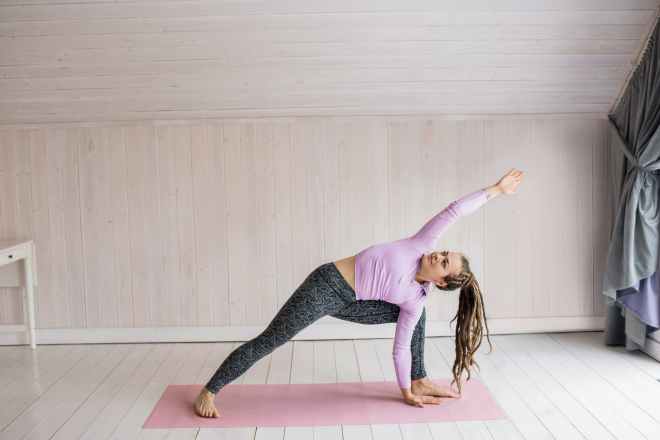
Compliments Other Stress Release Methods
Double your stress relief benefits by stretching …
- While in Nature (Stretch at the beach, in the forest, park, or after you’ve hiked to the top of that mountain.)
- During your Mindfulness (Stay in the moment while stretching.)
- With Breathing Techniques (Proper stretching is done with proper breathing. More on that below.)
- When Taking some Me Time (While taking time for yourself do a couple of stretches before or after.)
- Many other ideas you may have. (Create your own customized experience while stretching.)
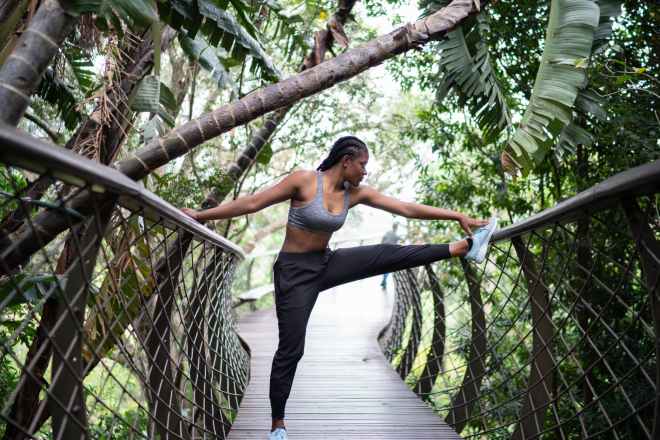
HOW TO PROPERLY STRETCH
If you’re going to take the time to stretch, you want to get the most out of it. And prevent injury. Please talk to your health care provider when adding or changing your exercise and health regiment.
Avoid injury by stretching when your muscles are warmed up. You can do a few minutes of walking, walking in place, jumping jacks, or after a shower or bath. Do not force your body to stretch or bounce with the stretch. Allow your muscle to only stretch to a comfortable spot.
Hold the stretch for about 12 seconds, longer if you can and want to, and only if you’re muscle allows it. You can start with a few seconds and always work up to a longer hold time if needed. Everyone has a different level of flexibility. Work in harmony with yours and not against it. You and your body will be much happier this way.
The key to the best stretch you can get is breathing properly. And relaxing into it.
1.) Take a deep breath from your nose before you stretch.
2.) As you do the stretch exhale from your mouth and relax. Relax the muscle you’re stretching and your whole body. You can do a few more of these breaths while in the stretch too. Do this by backing out of the stretch a little bit or restart the stretch, then take a deep breath in through the nose and as you exhale through your mouth, stretch and relax.
3.) If it helps, you can close your eyes as you exhale to focus on truly relaxing. You may be surprised to find what areas of your body you’re unconsciously tensing. I like relaxing nature sounds or music while I do my stretching to help me relax even more. Another way to combine stress reduction techniques.
This may be a new way of stretching for you, but as you can see it’s as easy as 1, 2, 3. I think you’re going to love this way of stretching as it really helps you to lower your stress level in just a few minutes.
It takes about 15 minutes or less to do a basic full body stretch. You can even break up your stretching into lower body and upper body if you have less time to do your stretching. It’s more important to do something than nothing. And remember the study mentioned said the participants only did 8 minutes of stretching to get heart benefits.
Let’s do some stretching and start reducing our stress today. You are well worth it!


Thank you for your Blog. I feel like I should say, thank you for my Blog. I say that because as I was reading, I felt this was exactly what I needed. I actually feel less stress knowing what I can do to lower my stress!!! I’m already thinking of ones I’m going to share this with. Excellent work, thank you again.
LikeLike
I’m honored and I thank you for your wonderful comment. I hope your friends will enjoy the information as much as you do. 😊
LikeLike