Breathing seems like such an automatic thing, learned at our first breath of life. Like that first breath of life, breathing techniques can help us survive the stresses of life.
When we are overwhelmed, too stressed, and really need to calm down, those are signals that we need some help. Our body is sending out an SOS to us. And we feel the urgency of it. That’s where breathing techniques help. They’re easy and can be done anywhere. There are many different ones. I chose ones that have helped me helped me to calm me down and ease my stress successfully. Let’s learn a few of these and what they actually do for our body.
For a condensed video version of this information, click this link https://youtu.be/WcLVzCLq85E
WHAT BREATHING TECHNIQUES DO FOR US
When we are anxious or feel stressed, the body responds by increasing our breathing with shallow breaths. This can lead to hyperventilating. Also, we feel a lot of muscle tension, sometimes pressure on our chest, and increased heart rate & blood pressure. Specialized breathing helps to:
– Slow down your heart rate
– Lower your blood pressure
– Ease tension in your muscles.
– Help you feel more present in the moment
– Less overwhelmed by stressful thoughts or emotions.
An overall feeling of relief is the result, allowing you to cope and handle the stressful situation. Or give you the courage to up and leave a situation if necessary. Sometimes you have to.
Let’s take a look at 4 different techniques.
5-FINGERS TECHNIQUE
A very easy technique that helps you slow down your breathing and focus on the present. A lot of the breathing techniques help you focus on the present, like mindfulness, and not on the stress.
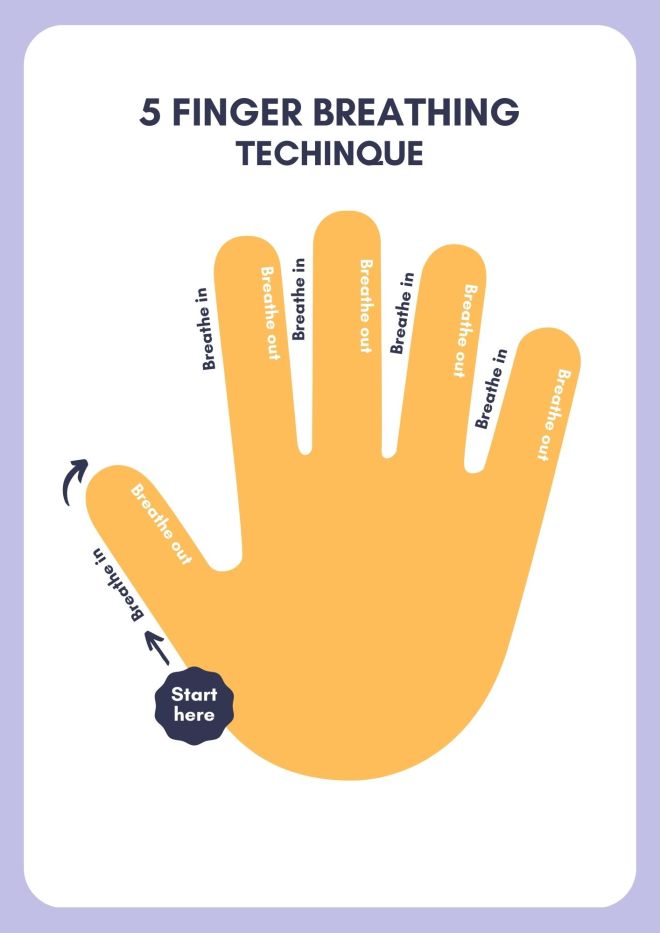
You will be holding out one hand and with the the other hand use a finger to trace it.
1. Hold your base hand in front of you (use your non-dominant hand to be more comfortable) with your fingers spread comfortably apart.
2. Starting at the bottom of the thumb, use the finger of your dominant hand to start tracing it up to the tip of the thumb.
3. As you begin tracing upwards take a nice deep breath.
4. Hold the breath for a second when you get to the top of the thumb.
5. Exhale on the way down the other side of the thumb.
6. Repeat with each finger. Inhale as you go up, hold it for a sec at the top, exhale as you trace the finger down the other side.
Feel free to position your hands in whatever way feels more comfortable for you. Here is a diagram of how to do this technique.
SQUARE TECHNIQUE
This is probably the easiest one to do. Look at or imagine anything in the shape of a square. You will…inhale for 4, hold for 4, and exhale for 4.
1. Start by looking at any corner of the square.
2. Inhale for a count of 4 as your eyes follow one side of the square to the next corner.
3. Hold your breath for 4 counts as your eye follows the line to the to the next corner.
4. Exhale for 4 counts as your eye follows the line to the next corner.
5. Continue to repeat until you finish the whole square and your breathing is calm.
How long and how many times you continue around the square is completely up to you. Thankfully the majority of us do not have to imagine a square as they are all around us.

POINTED TONGUE TECHNIQUE
Okay it does sound a bit strange, and you will not be sticking your tongue out at anyone. It does require a bit more focus so the stress should reduce more quickly. And hopefully trying to do this doesn’t create more stress. Nah, you got this!
1. Keep your mouth closed and touch the back of your top teeth with your tongue. As if you are saying the letter L.
2. Breathe in deeply and let it out deeply. Keeping your mouth closed and tongue pointed at your top teeth.
3. Take this to the next level and as you exhale, purse your lips like you’re going to blow out a candle. (Optional step.)
4. Repeat until calm.
4-7-8 TECHNIQUE
This is great for helping to sleep at night!
This breathing exercise was invented by American sleep expert Dr. Andrew Weil to help people relax before bedtime so they can fall asleep better and faster. So please do this when you don’t have to drive or operate equipment. Just in case. This works by calming your nervous system. Or as he says “it is a natural tranquilizer for the nervous system”.
This one you should start off slowly with 4 rounds of breathing or even just two. You can work up to 8 rounds as you get used to breathing this way. Find a comfortable place to sit upright. You should not be slumped over to make sure you get a full breath. Or if you will be doing it right before sleep you can be laying down.
1. Like the “pointed tongue technique”, comfortably place your tongue at the top at the back of your front teeth. Keep lips slightly parted and completely exhale noisily by letting the breath whoosh out of your mouth.
2. Inhale in this position with your mouth closed for 4 seconds.
3. Hold the breath for 7 seconds.
4. Slightly part your lips. Exhale with noise (“Whoosh” or “Ahhh” that stress out) for 8 seconds.
5. Inhale again for 4 counts to begin your second round of breathing.
You can do this technique twice a day or whenever you’re feeling the stress coming on.
Since this technique can be a deeply relaxing experience, please pick a place that allows you to relax or fall asleep comfortably.
SUGGESTIONS
You can do these while enjoying other forms of stress reduction. Such as while in Nature. Or during a Mindfulness session. Possibly while Stretching. Combining stress reduction methods is a great way of managing anxiety and stress.
Try to find time each day to incorporate a breathing technique. And try different ones that work for your circumstances. You could do a morning wake up breath. Use one as a mid-day stress crusher. Or include one as part of your wind down or bedtime routine to have calmness and ease into sleep. And of course, whenever you’re having an SOS moment. Which technique will you try?

 Stress Less Today